By my request, the back covers of both Boys of Steel: The Creators of Superman and Bill the Boy Wonder: The Secret Co-Creator of Batman had only one line:
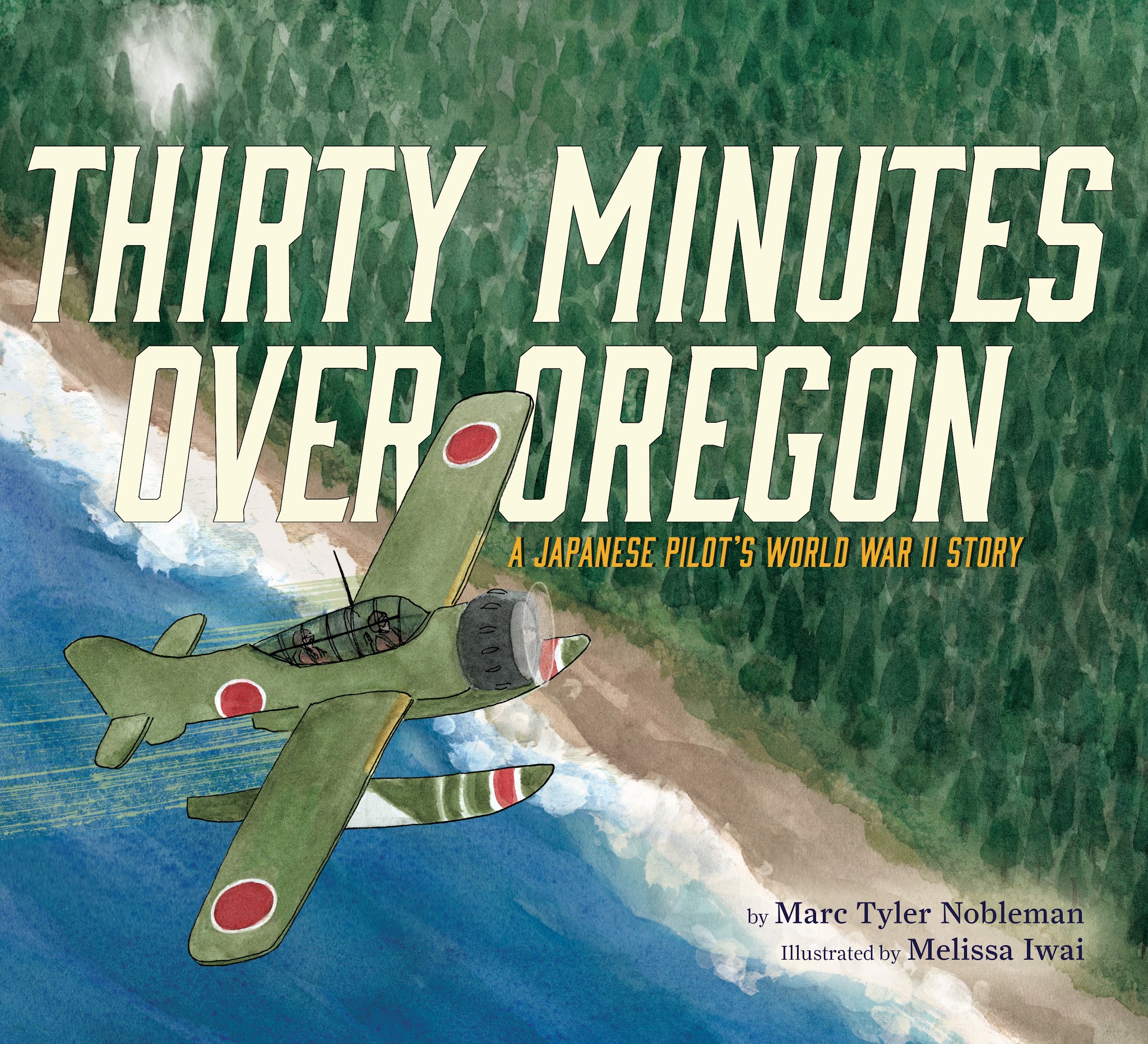
I wanted to keep that going with Thirty Minutes Over Oregon: A Japanese Pilot's World War II Story.
Though in this case my proposal was two lines, it had a similar effect:
In 1941, the surprise Japanese attack on Hawaii brought America into World War II.
In 1942, the Japanese pilot Nobuo Fujita brought World War II into America.
I love the image and it is a mysterious contrast to the war scene of the cover (which stokes curiosity), but I still visit the alternate universe where my suggestion came to pass.
Welcome school principals, school librarians, and PTA members!
If you are here because you searched “marc nobleman author visit” or “marc nobleman school visit” or “marc tyler nobleman author visit” or “marc tyler nobleman school visit,” your results probably also included a paywalled article with this headline:
The article was written by Nancy Preyor-Johnson and published on 10/6/23 in the San Antonio Express-News.
Nancy did not hear my talk.
The article is wrong.
Northside ISD was wrong to cancel my author visit.
Rather than judge me based on only that one Texas headline, please read this (or at least skip to the Northside educator tweets at the end):
I went to do school visits in Northside ISD in good faith and treated all with respect, as I have at hundreds of other schools in 30+ states and almost 20 countries over the past 20 years.
I gave the same talk I’ve given hundreds of other times.
Three examples of the kind of reaction I typically get:
“In my almost three decades of teaching, I have heard a wide variety of internationally known authors, many of them award recipients. Marc was easily the most engaging and inspiring presenter I have ever heard. He held the rapt attention of the entire auditorium—students and staff alike. He is such a gift!”
—Adrienne DeMichele, Taipei American School, Taiwan
“My principal and almost every teacher said this was the best assembly they have ever attended. Educational value? 5 out of 5 stars. Entertainment value? 5 out of 5 stars. Marc’s amazing story kept an entire room of students and teachers enthralled for an hour with no special effects or tricks.”
—Jamie Harris, librarian, Smalley Elementary, Las Vegas, NV
“I have known Marc for eight years and I can tell you with complete honesty that he is the best, the very best, in inspiring children. He is able to empathize with them (and adults, also) to an incredible degree. As a matter of fact, he becomes a role model for many of them. One fifth grader wrote in his evaluations, ‘Mr. Nobleman’s name fits him. He is a noble man.’ His books have the same kind of integrity. I cannot recommend him highly enough.”
—Susie Mee, Director, Authors Read Aloud (a Learning Leaders program), New York, NY
My talk lasts 60 minutes.
In that talk, I say that someone was gay. One time.
I also refer to straight marriages. Multiple times.
I was scheduled to speak at Northside schools for 10 days.
The first nine days went great.
Except for the two parents who contacted their school because I said “gay.”
Neither had heard my talk, read my books, seen my documentary, or met me.
Yet their complaint pressured Northside into giving me a choice: leave out the word “gay” on day 10 or there is no day 10.
The kids were disappointed. School staff was disappointed. I was heartbroken.
But the people who truly suffered were the LBGTQ members of the Northside ISD community. Northside ISD’s action signals to them that their very existence is taboo to mention. Northside ISD made them feel unwanted and unsafe.
Northside ISD was wrong to cancel my author visit.
Northside ISD prioritized the ignorance of two adults over the enrichment of hundreds of kids.
Northside ISD was wrong to cancel my author visit.
Because two adults thought kids should not hear the word “gay,” those kids also did not hear a jaw-dropping story of persistence. They did not hear about the adventure of primary research, the thrill of reading, the calling of speaking up for others, and the imperative to give credit where it’s due.
Northside ISD was wrong to cancel my author visit.
But hopefully a message from my story did trickle down to at least some NISD day 10 kids from enlightened NISD educators and parents: when you have to choose between siding with the tolerant or the intolerant, there is no choice.
Northside ISD was wrong to cancel my author visit.
In closing, here are reactions to my talks from NISD educators (i.e. people who did hear me present and who have the best interest of the kids at heart):
Fifty years ago today, the classic sitcom Happy Days premiered.
To celebrate, rock out to an interview with Truett Pratt, half of Pratt & McClain, whose 1976 recording of the theme song became a hit.
What were you doing professionally prior to Happy Days?
I was a child. [laughs]
I have been told that I was singing harmony at 3½ years old. In my youth, I spent a large amount of time with my musical friends and was involved in both church and school music, vocally and playing first trumpet in the marching band.
My senior year, I provided the musical entertainment for the Miss Teenage America competition in our South Texas region. Six weeks after graduating, I got a call from the entertainment unit of Chrysler.
They were putting together a massive promotion—they gave 7,000 cars free every year in small towns and at colleges because the driver education students were there but they had no vehicles. They were giving cars because they were good citizens. A year later they bought them back and sold them as demos. This was 1967-68.
[They sponsored a singing group] called The Spurrlows, and after a 30-second non-rehearsed audition, I received an invite to [join] the 26-member act. I was the youngest.
We traveled and performed everywhere from colleges to high schools to public venues like malls, sometimes 4-5 shows a day with costume changes.
I did the television appearances. I was on the centerfold of Life magazine with our cars.
The other folks traveling with us were, for the most part, active in their churches as well. Most of the nights on the tour, they performed a sacred concert of beautiful traditional music.
One time I woke up mid-morning and I was fully dressed on a stage performing for about 600 people. I’d arisen, showered, got in my car, went to the performance, and came into consciousness on stage. And I believe it was the second wardrobe change of that show! [laughs] I was thoroughly worn out in under 11 months.
After [doing that] tour [for a year], I attended a well-known university for one year. The policies of the school and the (most important) location soured my attraction and was truly a “down” year for me. Fortunately folks had seen me and my talent, that leading to an invitation to come to Los Angeles, the start of my career.
What songs were you singing?
In the daytime, our 90-minute performance [included] contemporary pop chart hits and traditional, well-known tunes. The night was a first class, more formal show, in tux and black tie.
How did you and Jerry McClain meet/start working together?
I moved to LA when I was 20 in 1970. About three or four months after I arrived, I got together with Jerry. My roommate had known Jerry from the music business in Los Angeles. Jerry and his wife and her twin sister had performed with a number of mid-60s pop groups. They’d had some success and done well in the commercial area of life as well.
My roommate thought Jerry and I would be a good match because I’m—not egoistically speaking—advanced in music. I sang and was first trumpet with the marching band and jazz band. I sang in church. I was eclectic and could handle different types of performance.
Jerry and I decided to move together on the future. We put together a very slick Las Vegas-style rock and roll act. We employed James Fitzgerald, husband of the movie star Jane Powell, to be our manager.
He notified agencies in LA. We put on an audition by renting a small rehearsal studio that could seat an audience of 200. We set up with matching outfits and we did 18 minutes, took a three-minute break, then did the same 18 minutes again—repeated for three hours. The agents who came to see us could come when they wanted and stay as long as they wanted. The next day we got a call from William Morris, the biggest agency in the world. Other agencies made a bid but William Morris was immediately organized and had the connections for our type of act. We started in the business at what I call the middle.
What was the name of that act?
Pratt & McClain and Brother Love.
Was Jerry your age?
Seven years older.
Your version of the Happy Days theme was used for seasons 3-10 (out of an 11-season show). How did you get the gig to record the theme?
We were already a successful nightclub act. Our business [model] was to tour about six months off and on, and [spent] the other part of the year working on our recording. Our first album was completed in late 1974. We got some airplay on album stations, but no blockbuster success.
One of my producers [who was also my former roommate] Michael Omartian moved offices to Warner Bros. We came off the road and, in April 1976, had a meeting with Michael and Steve Bari, who already had 21 gold singles—the Turtles, the Grass Roots.
We discussed the fact that the show Happy Days was an instant hit and we should make a “Happy Days” record. The song was written by Norm Gimbel [lyrics] and Charlie Fox [music]. I guess you’d call them well-known. The 20 seconds you hear on the show were studio singers.
We got permission from the clearance houses to record that song. The first meeting was a Friday morning. Since we used the finest players in the industry, we couldn’t get everyone for five days. By the following Wednesday afternoon, we’d done all vocals and background instruments. By Friday night, it was hand-carried by couriers to the largest radio stations in the country for national release at 8 pm in every time zone. First meeting to finished record in seven days. [Then] “Happy Days” was being played every hour on the hour.
The song was on our second [and final] album, Pratt & McClain Featuring Happy Days.
Did you write for your albums?
Two of the songs on the second album are mine: “California Cowboy” and “Summertime in the City.”
Was your “Happy Days” song written to be used on the show or intended only to be a single?
Once the show was a hit, Garry Marshall [the show’s creator] contacted Gimbel and Fox and they wrote up the lyrics. I don’t think it was ever intended to be a single. It was intended to be used for the show but then became a single as well. Almost simultaneously. We saw a business opportunity to give product where there was no product.
Were you already a fan of the show?
When you travel the way we did, and are otherwise busy in studio, I didn’t have much time to watch TV. I was familiar with the show but not an avid fan. [But then] after viewing episodes, I became a big fan…and a grateful fan!
What interactions if any did you have with the stars of Happy Days?
We were never on set. We didn’t have any affiliation with the show other than being booked on some TV talk shows—Mike Douglas, Merv Griffin—with some of the side actors like Ralph [Don Most] and Potsie [Anson Williams]. They were guests, not singing with us. The shows would pick us up in a limo. When we’d arrive, there’d be people everywhere and we could barely get out. It was like the Beatles!
I would see Ron and Clint Howard at a Christmas/Chanukah party I attended for some years. They were great, very down-to-earth.
Have you met any of the cast over the years?
No. But others. Christina Applegate babysat kids in the neighborhood just before Married… With Children. I can’t remember if she babysat mine. My older son learned to shoot pool two houses down with Mr. T. The neighbors were all friends. It was a quiet neighborhood in Sherman Oaks. Henry Winkler’s house was less than a mile away. I remember standing in line at the grocery store having a serious conversation with Don Cornelius of Soul Train. That’s what life was at that time.
Is Jerry McClain still with us?
He is, what’s left of him.
Our second release [the album with “Happy Days”] hit the top 40. We’d be partners for 7-8 years. We truly became brothers. Our traveling life was usually interesting. It had its ups and downs. After our second release “Devil with the Blue Dress” hit the Hot 100 on Billboard, he started partying and got completely addicted to cocaine. It started out with Jerry pulling no-shows for radio promotions. He was hanging out with what he called a record promoter—I called him Jerry’s new girlfriend—who was really a coke dealer.
He never really came back. He hit the skids, as most addicts do. I got away from him as quickly as I could. But he damaged my reputation deeply. By the time I started to unravel the mess, he had drained every dollar of our bank account. This was about 1978-79. I don’t lie, cheat, or steal. I learned a big lesson watching my business partner lose everything.
I had to sue him five years ago. A friend at Warner Bros. called me. I was the first recording artist he’d worked with at Warner Bros., 40 years ago. He was the worldwide head of royalties till he retired two years ago. He asked how I’d been liking those “Happy Days” royalties. I said “What royalties?” He said he’d call me back in five minutes but called in three.
He’d hit one button on his accounting computer and brought up the past 15 years. Jerry had called a secretary in the royalties department to somehow [redirect my portion of the royalties] to his house in Burbank. He also forged my name.
It turns out Warner Bros. had never failed to issue me a royalty check every six months for the last 47 years.
His behavior and choices at that time [led to] a very long recovery. It’s horrible… I wish him the best.
I’m so sorry to hear this. For how long was your money being sent to him?
Probably 30 years!
Did you assume you weren’t getting payments because the royalties had simply dwindled to nothing?
Of course.
So you get royalties now?
Yes. It’s pretty steady because of streaming—Apple Music, Pandora. It doesn’t pay the bills now, but years ago it was a lot of sales.
Do you know roughly what you’ve earned from the song?
No. Forty-seven years is a long time!
Where do you live?
I got turned off by the ego. I’m just a Texas boy, two feet on the ground. I moved from California back to my hometown San Antonio around the end of 1997. I’ve been around the world 4½ times. I’ve had dinner with kings and dated their daughters. Nothing comes close to Texas Hill Country. I was born and raised here. The residence I’m talking to you from, I first spent the night at when I was 6½ years old.
Children?
I have two sons, two daughters-in-law (six college degrees in that bunch), two grandchildren by each couple, all very happy and doing very well. I also have two buttons on the chest of my shirt that pop open whenever I talk about them!
What are you doing these days?
I am just enjoying the heck out of life, brother. I have assets, multiple streams of royalties. I did 12 cruises in the last 14 months with my girlfriend Jackie.
I had to be careful for a while because of what Jerry did to me. I’m multi-talented. I’ve always been a real estate animal. I started learning all the aspects of real estate development. I went to contractor school and got a license in California.
I started two companies. One was called Airport Flyer Systems. In 1983-85, I created and put into action the airport bus system in Houston, TX. It’s the fourth largest city in the U.S. in population and the largest city in the world in square miles and has two airports—but had no bus system!
To accommodate the schedule of my two children, to be best provider I could be, I got into the finance of real estate. The way the lifestyle is in that industry, I could have control of my schedule. I started at the very bottom. I was an assistant processor and complete gofer in the mortgage business. Spent 1½ years learning the business at a wholesale mortgage money source. I became a full real estate broker. I have had a mortgage company for just under 25 years. I ended up lending in California and Texas—two completely opposed systems.
Have you ever participated in a Happy Days-related event (reunion, convention, documentary, etc.)?
I have not because back then they didn’t have them.
Would you now?
Sure, of course. Why not! I am a friendly guy and have always valued interfacing with folks. My friends jokingly compare me to Will Rogers who “never met a stranger…”
Do you have any mementos from your Happy Days experience?
Gold record in my hallway, photos of all kinds of folks, and volumes of memories.
What did you think when you got my interview request?
I’d been approached before but those people were not as succinct as you so I thought I’ll answer you. [laughs]
How do you look back on your Happy Days experience?
Tremendous gratefulness.
I have been blessed with a colorfully unique life experience, one heck of a rollercoaster ride—a truly mind-boggling ride—with a view from the top of the world.
From “Happy Days” success, I gained the seasoning to encounter other business challenges and to achieve success in most of them, allowing me to own my schedule and continue to travel the world. I’m truly enjoying the fruits of my labor and spending time with my posse. For example, my older son and I own the newest Gold Wing touring motorcycles (among others) and will be leaving on a trip to the western U.S.
I’m occupied at this time writing [a book]. The title: Memoirs of an Almost Rock Star and How I Survived.
Why “almost”?
We could have gone much further if my partner had not gone to another planet.
I [still] perform 4-5 times a month when I’m home.
And I am happy, the most important factor of all. I am truly living in Happy Days!
The first round of sketches Ty Templeton submitted for Bill the Boy Wonder were so good that I requested few changes.
The biggest one, as I recall, was the spread in which I briefly summarized the murder of Bruce Wayne's parents. I say they were shot but felt we should not show that.
Unaware of my feeling, Ty created this concept:
Strong! But wrong, in my opinion, for the format. The book would be intended for grades 3 and up, by which age kids (unfortunately) already know about guns and likely murder—but it might also be read to kids younger than that.
He kindly obliged me by retooling, and that, too, was strong. I liked it better for more than one reason—now we also see the Waynes. The image conveyed menace without depicting the shooting:
On my last day in Oman (and the Middle East), I got picked up at 6 am and was driven 1.5 hours to Wadi Shab, an unusual and largely pristine hike through a relatively narrow, boulder-strewn valley.
First you pay $2 for a two-minute boat ride to the start of the hike.
After an hour, you reach a point where you must swim or wade through three clear pools to get to the big finish. The last pool is too deep to stand.
Unless you used a waterproof bag, you leave whatever you brought on the shore before the first pool. For me this included my phone, eyeglasses, and sneakers (I changed to water shoes). Though I knew in advance that I’d have to do this and was assured it’s generally safe, I nonetheless hid my backpack in a crevice rather than leave it out in the open as others did.
the first of the three pools (from a slight distance)
As with my visits to Jerash and Petra, I went without a guide. Unlike Jerash and Petra, Wadi Shab really doesn’t necessitate one. It’s a straight if rugged shot—no way to take a wrong turn when you are at the bottom of a gorge, though sometimes I had to figure out a way around an impenetrable cluster of boulders or swampy patch.
For most of the hike, I was the only human in sight. (I did spot a gray snake and a heron.) Once I got to the pools and lingered, people began to appear behind me, including a boisterous group of men I soon learned were off-duty soldiers.
At the end of the final pool is a triangular-shaped opening just big enough for a human head. If you didn’t know to look for it, you’d miss it.
You half-swim, half-tread through this channel to emerge in a cavern with a waterfall (and nowhere to stand or sit). There is a rope attached to the rocky slope alongside the waterfall, but I did not try to climb up. Instead I soaked up the atmosphere while treading water for a couple of minutes, taking photos with my mind since my phone was (hopefully still) a few pools behind me.
When I swam back to the short stretch of rock between the third and second pools, I volunteered to watch the phones of a soldier and a woman from Slovenia who had both managed to take their phones through pools 1 and 2. The Slovenian woman then took a video of me jumping from a rock ledge into the third pool and took my email to send it to me. It’s been more than a week and still no email, sadly. I hope she remembers soon.
Even if not, I will remember the experience as a Middle East highlight.
tiny waterfall on the way back to the entrance
Spotted on the way back to the city. Corn, anyone?
After a profound week in Jordan, I flew to the bottom of the Arabian Peninsula to speak for three days at the American International School of Muscat in Oman.
I arrived on 10/15/23, then stayed in my fifth hotel in five nights (10/11 Amman, 10/12 Petra, 10/13 Wadi Rum, 10/14 Amman but only for a few hours because my flight to Oman departed at 2:25 am.).
As with my host Paige Spilles at the American Community School in Amman, I was blessed with a standout host in Ryan Callaway (who has worked with my Paige). He picked me up at the airport, took me to dinner with colleagues, invited me to play ultimate frisbee with staff in 100° weather, invited me to his home, and recommended/found me a guide for Wadi Shab.
The Israel-Hamas war was in week 2 but Oman is further removed than Jordan both geographically and culturally. I’m told there are few Palestinians at the school and in the country (not that only Palestinians have strong feelings about the situation).
As with ACS, I worked primarily with high schoolers: an assembly, a breakout writing or visual literacy workshop with each class, and a screening of Batman & Bill (for staff).
Thank you again to Ryan and TAISM for hosting me with such warmth.
Two hours south of Petra, I spent the night on Mars.
the small arch
To be precise, I spent the night in the desert of Wadi Rum, which is close to the borders of Israel and Saudi Arabia. (In Arabic, “wadi” refers to a valley, ravine, or gorge.)
Scenes for films including Lawrence of Arabia (1962), The Martian (2015), and Dune (2021) were shot there.
There are no roads. There are no hotels. There is just majestic nature—and trucks that drive you to and through it.
After getting settled at Memories Aicha Camp (recommended by a colleague and worth the splurge), I set out as the lone passenger in the back of a pickup truck for a three-hour tour of the desert, culminating in sunset with shisha (except me) and tea.
wider view of the small arch
Lawrence of Arabia (allegedly) slept in this
partially collapsed structure
This is how you get to the big arch.
That’s my butt halfway up.
Before entering a short, narrow passage to climb up
to the bridge, you need to navigate a narrow ledge
with people coming back from the bridge.
When a woman in front of me saw the tightness
of the passage, she turned back.
worth it
Of the four historic/natural sites I saw on this Middle East trip (Jerash, Petra, Wadi Rum, and Wadi Shab in Oman), Wadi Rum was the only one for which I hired a guide…because you have no choice. The desert is (obviously) vast and would be treacherous for the average tourist to wander on foot. Hamed (age 21) knew the hotspots among the hotspots and had the wheels to take me to them in a reasonable amount of time.
I was expecting the desert to chill off after dark, but on this particular night it felt just right. I wore the same thing at night as I did during the day and wasn’t hot or cold in either case.
Moving through the desert was hypnotic. At times I had to snap myself of a trance of sorts, reminding myself to focus on the otherworldliness all around me. The landscape did vary and called to mind stories unknown of nomads of the past who inhabited that unforgiving environment. I craved to catch some vestigial extrasensory glimpse of their lives. No such luck.
This masterpiece, Al Khazna (AKA the Treasury), is a stone-cut temple near the entrance of Petra, a onetime capital city winding among rock cliffs of Jordan.
When it appeared in the climactic scene of the 1989 film Indiana Jones and the Last Crusade, many Americans had no idea what it was.
But that first impression was built to last.
On 10/13/23, I got to visit Petra, and it instantly assumed the number 3 spot on my list of most stunning sites I’ve seen in real life (following Easter Island and Machu Picchu). *
The date of construction is uncertain. Petra was the capital of the Nabataean Kingdom, which flourished in the first centuries BCE and CE.
The site opens at 6 am, so I got there at 5:59 am—and was about tenth in line.
Petra is more than the iconic Treasury that welcomes you to the site. It’s an assortment of ancient temples, tombs, and other structures, some built into cliff faces. The bookend attraction is Ad Deir (AKA the Monastery), which resembles a wider variation of the Treasury. (The walk from the entrance to the Treasury is approximately 1 mile, Treasury to the base of the steps to the Monastery approximately 2 miles, and steps to the Monastery: 800. Then you have to walk back.)
Some recommended that I enter at the back of Petra, which involves boarding a truck for about 20 minutes to a point where you start walking to the Monastery. An upside: you would then walk from the Monastery to the Treasury and out—in other words, downhill and one way. A downside: by the time you get to the Treasury, it will be mobbed with tourists and camels—nearly impossible to get a solo photo.
So I did not do that. I started at the start, walked all the way from the Treasury to the Monastery, then doubled back. I arrived at the Monastery at 8:15 am and arrived back at the Treasury at 11 am. It’s a better workout, plus you see everything along the trail twice, from a different angle and in different light. You also notice things you didn’t the first time.
An American who grew up in Jordan and attended ACS told me that the school used to take students on camping trips in Petra before it was a heritage site. No guards, no tourists, no merchants. The kids were given free rein to set up their sleeping bag in whatever cave they wanted. Some got too bold, went a bit too far, got scared, and relocated closer to others.
Highlights of my visit to Petra:
surely an authorized use of Harrison Ford’s likeness
and the IP “Indiana Jones”
The Siq
(gorge that leads you into Petra proper)
I arrived even before the camels,
but just barely.
Not only my first time at Petra but also
my first cargo pants!
the Royal Tombs
“big sale”
the Monastery largely to myself
Across a sand plaza, facing the Monastery, are shops.
I am assuming this boy is the child of one of the employees.
Visitors willing to climb have multiple options for
vantages like this...
...and this.
A visitor facing a formidable ravine (and Israel).
This Bedouin, who called himself “Arab Jack Sparrow,” lives in an open-air house in Petra, overlooking the ravine shown immediately above. He kindly lets tourists into his home throughout the day and offers drinks and trinkets for sale. He says he can get a cell signal from Israel and has wifi in a nearby cave, where he also retreats during inclement weather.
his house
admiring someone admiring the view
Zoom in to see the start of the 800 steps to
the Monastery.
This is 11 am and this is why you want
to get to the Treasury first thing.
what I brought to Petra in my new desert cargo pants
As I politely declined purchasing anything in a particular, the merchant popped her head out as I walked on and said “Good when you smile.” It was so sweet but also sad because it suggested that many others don’t smile when they pass—and some surely don’t acknowledge her at all. I asked if I could take this picture and she said yes...with a smile.
* My personal list of New Seven Wonders (considering only places I’ve been):

.jpg)


%20-%20phenomenal,%20impact.jpg)
%20-%20so%20intriguing,%20now%20to%20watch%20doc.jpg)
%20-%20amazing,%20captivated.jpg)
%20-%20amazing.jpg)
%20-%20inspiring.jpg)


.JPG)

